Instructor Spotlight: Frank Sobchak
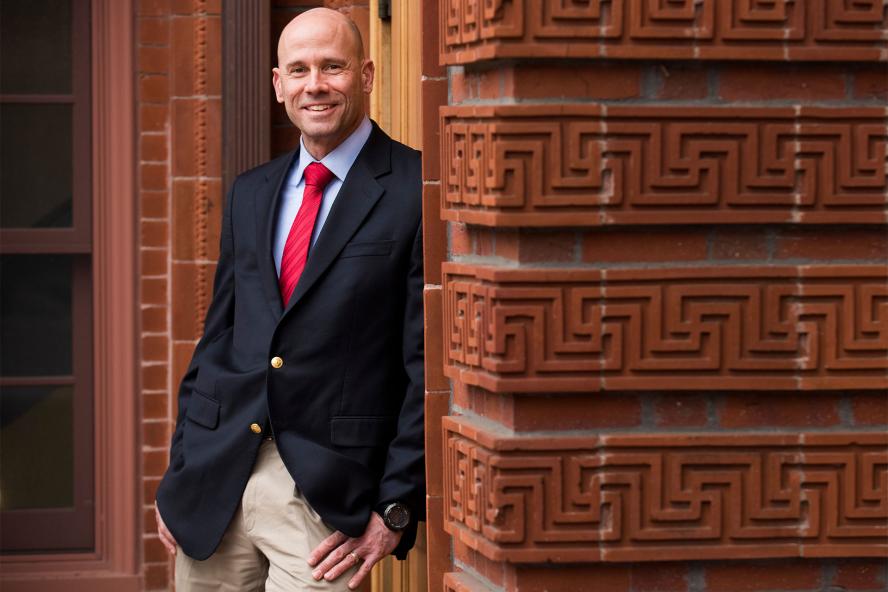
Tell us about your background and what inspired you to teach this course
I served 26 years in the Army, first as a military intelligence officer and then as a special forces officer (green beret). Across my career I served in counternarcotics missions, training missions, peacekeeping missions and in combat, with major deployments to Kuwait, Kosovo, and Iraq. I was fortunate to have some amazing jobs while I served, acting as the garrison commander at the Army base at Natick, MA, which is like being a city manager and mayor combined. In addition, I worked as a liaison between US Special Operations Command and Congress for four years and then helped write the official history of the Iraq War for the Army.
I was actually inspired to teach this course because of a course I took as a cadet at West Point. The course was named Combat Leadership and it was taught by a veteran who had fought against the Soviet invasion of Hungary and then in Vietnam. Rather than rely on readings, he used war movies as a teaching medium, and it was probably my favorite undergraduate class. That experience really keyed me into the power of teaching in a nonstandard medium. While a course on combat leadership would not be applicable, this class combines two of my passions: War films and politics.
What is your favorite war movie?
There are so many good ones. My top three would be Saving Private Ryan, Inglourious Basterds, and Dr. Strangelove. If I was really pressed, I would probably say Saving Private Ryan.
What is one thing you think film and reality could learn from each other?
Ah, the question of art imitating life and life imitating art. Great question! One of the films that is watched for homework before the first lesson, is Seven Days in May, a 1964 John Frankenheimer film that depicts a hypothetical military coup of the U.S. government (which is grounded in the civil-military friction between the Kennedy Administration and his military leadership during the Cuban Missile Crisis). The coup is ultimately stopped by an officer (and others like him) who, despite his misgivings about the decisions of the president, knows - fundamentally- that his duty and oath is to the U.S. Constitution. Not to the country, not to a president. To the Constitution.
Because of that, he sides with the President (who is making an unpopular but legal/lawful decision for complete nuclear disarmament) against other military leaders, including his personal mentor. When I was a junior officer, that film was shown as professional development so that we understood our duty and responsibility- that we were to follow only lawful orders and that our responsibility was to the Constitution. I don't know if it is still being used in such a way, but it was a superb method to inculcate the essence of an officer's duty, and I think life- military and civilian leaders- could learn a lot from that film.
What do you hope that students will take away from your course?
There are two central objectives to my course. First, to understand that nearly every war film has some sort of political subtext- a message that it is trying to deliver- and to be able to recognize those subtexts, even as concealed or subliminal as they could potentially be. Second, is to bridge the gap between the U.S. military and the public it serves. The percentage of the U.S. population which has served in the military is currently at around 6% and continuing to drop. War films try to show us (American veterans), our history, and our culture to the public. Sometimes they do a good job, sometimes they do a terrible job, and sometimes in between. I hope my students walk away with a better ability to watch war films in the future and say, "that seemed really made up" or "that really captured the culture well," depending on the movie.
Dr. Frank Sobchak's interview reflects his own personal opinions and does not reflect the official policies or positions of the Naval War College, U.S. Navy, Department of War, or of any entity of the U.S. government.