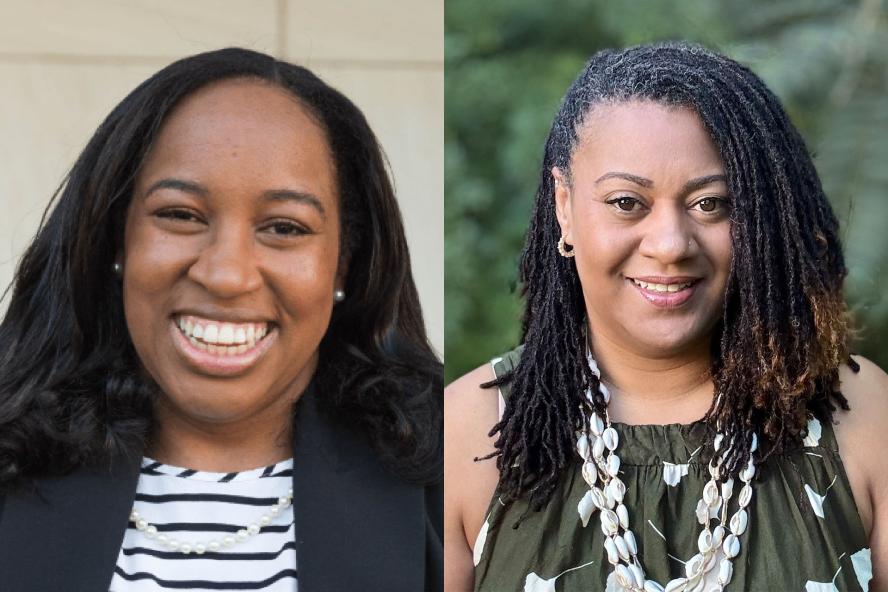
Instructor Spotlight: Cynthia N. Perry and Daniela J. Harrigan
What inspired you to teach this course?
Daniela: I was inspired to teach this course because of the transformative experience Cynthia had last academic year. She believes deeply in the mission and vision of the ExCollege, and she also believed that we, as womanist scholars with distinct yet complementary lenses, had something meaningful to offer Tufts students. More importantly, our pedagogy itself embodies womanist theory: it is collective, communal, and grounded in ancestral wisdom, lived experiences, and rigorous academic inquiry. Teaching this course is an opportunity to model a decolonized, relational, and justice-centered approach to learning—one that honors the fullness of our students and the communities they come from.
Cynthia: I was inspired to teach this course as a way to engage the long history of Black women who have always worked across multiple disciplines and social locations. The course invites students to consider how Black women are remembered—or forgotten—through archives, media representations, and our own collective and personal memories, and to interrogate whose stories are preserved and whose are erased.
What does it mean to be a Black superwoman?
Daniela: A Black superwoman is someone who honors the fullness of their multiplicity and embraces it as a source of power. She lives in the sacred both/and: strong and soft, productive and at rest, steadfast and tender. She refuses the lie that she must choose one way of being worthy. Instead, she embodies balance. When she is aligned, she attracts what nourishes her, and she becomes full enough to pour into others, should she choose. Her superpower is not endless labor; it is the wisdom to move through the world with intention, integrity, and a deep sense of self.
Cynthia: To me, a Black superwoman is a Black woman who loves herself and others across differences of race, religion, politics, gender identity, and sexual orientation, while actively working to dismantle systems of oppression. Crucially, she understands that liberation work requires rest, peace, and joy—not constant self-sacrifice. Because the work of justice demands more than any one person can carry alone, she draws upon spiritual and ancestral technologies to imagine and conjure new possibilities. In doing so, she helps cultivate an ethic of care for herself and her communities.
What are the differences between feminism, Black feminism, and womanism?
Cynthia: Feminism is a broad social, political, and intellectual movement committed to ending sexism, sexist exploitation, and oppression. Feminist theory examines how gender structures power, labor, bodies, and knowledge, and it advocates for gender justice across social institutions.
Black feminism centers the interlocking systems of oppression that shape Black women’s lives—particularly racism, sexism, classism, and heteropatriarchy. It argues that Black women’s experiences cannot be fully addressed by either mainstream feminism or Black liberation movements alone.
Womanism, a term coined by Alice Walker, is a social, cultural, ethical, and theological framework rooted in the lived experiences and spiritual traditions of Black women. Womanism emphasizes wholeness, community, embodiment, spirituality, justice, and survival, attending not only to race and gender but also to family, ecology, sexuality, faith, and communal flourishing.
Why is it important to make distinctions between the three?
Daniela: It is important to distinguish between the three—feminism, black feminism, and womanism—because each tradition emerges from different lived experiences, cultural lineages, and political needs. “Mainstream” feminism has often centered the realities of white, middle-class women, which means it has not always accounted for the intersecting dynamics of race, gender, class, sexuality, and culture which shape the lives of Black women, and other women of color. Black feminism arose in response to those gaps, naming specific ways Black women experience oppression and the ways we generate knowledge, resistance, and community.
Womanism goes even further. It grounds itself in the spiritual, communal, ecological, and ancestral traditions of the African diaspora. And while it centers the experience of Black women, its aim is liberation for all.
Who is your favorite Black woman that you are highlighting in your class this semester? Why?
Daniela: There are so many women I could name, and choosing one feels almost impossible. But given the times we are living in, the weight in the world and what we carry in our bodies, I want to lift up Tricia Hersey, author of Rest is Resistance. In moments when we might feel compelled to pick up the mantle, to confront and resist the systems which harm our collective well-being, rest—true rest—is often the first thing we abandon. Hersey reminds us rest is not a passive luxury, but a radical, political act of refusal in a society that equates worth with productivity and exploits bodies as instruments of labor. As she writes, “rest is a divine right. Rest is a human right…. Rest must interrupt…. We must reimagine rest within a capitalist system.”
Cynthia: Serena Williams. I am especially excited to explore what I call the “Serena Williams effect”—the profound impact she has had on the sport of tennis and on Black women athletes more broadly. Her legacy is visible in players such as Coco Gauff, Taylor Townsend, and Naomi Osaka, whose presence and success in tennis would be difficult to imagine without Serena’s trailblazing career.
What do you hope that students will take away from your course?
Daniela: My hope is that students deepen their knowledge and understanding of the images and stories that have been used by, for, and against Black women in the United States. Ultimately, I want them to cultivate a healthy, holistic working image of Black womanhood and to reimagine their own stories, crafting counter narratives that resist, disrupt, and subvert master narratives.
Cynthia: I hope students leave with an understanding that historical records of Black women have often been erased, incomplete, or distorted. Counter-memory and storytelling are therefore essential practices for preserving Black women’s sacrifices, creativity, and contributions to society. Through archives, music, film, and embodied practices, students will see how Black women imagine new futures. This connects to the concept of the Black fantastic—not only as an artistic framework for envisioning Black culture, but also as a political strategy for creating alternative futures grounded in thriving rather than mere survival.
Cynthia N. Perry is an entrepreneur, non-profit leader, and lecturer. She earned her Master’s in Sports Management from The George Washington University and her Master of Divinity from Boston University School of Theology, where she was a Howard Thurman Fellow. Cynthia is the Co-Founder and Executive Director of The Black Sports Ministry Network, Inc. She previously taught EXP-0008-S Sports, Religion, and Social Justice in the ExCollege.
Daniela J. Harrigan is a Black, Cape Verdean American chaplain, holistic wellness leader, scholar, and educator. She earned her Master’s in Criminal Justice from Suffolk University and is a Master of Divinity candidate at Boston University School of Theology. She currently serves as Director of Community Engagement for the MA Department of Mental Health (DMH).